

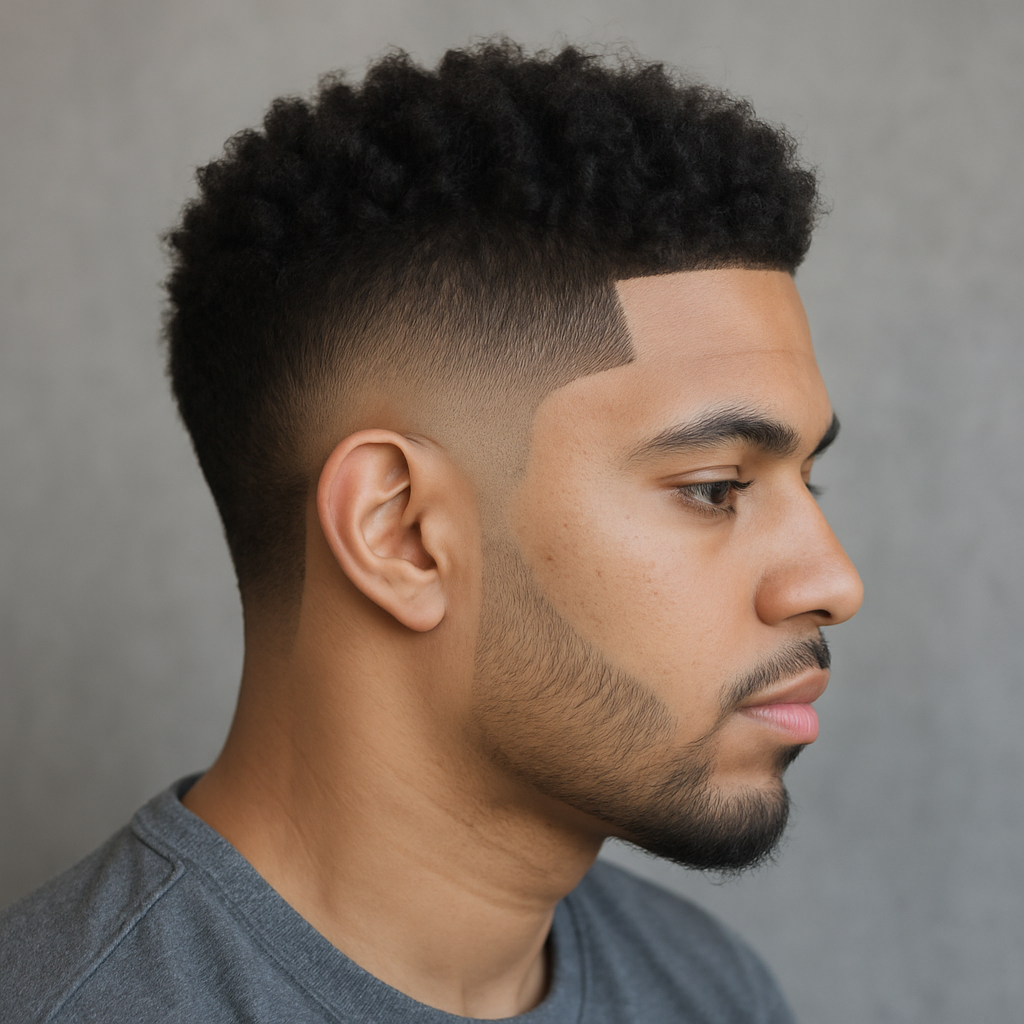
What Is a Burst Fade?
The Shape and Silhouette
A burst fade is a curved fade that radiates around the ear like a sunrise—tightest right behind and under the ear, then “bursts” outward as it blends into longer hair above. Instead of dropping straight down the neckline, the fade arcs around the ear and typically keeps some weight behind the head. That round silhouette is the signature: crisp, clean edges with a soft, circular blend.
A Quick Origin Story (a.k.a. “South of France” cut)
You’ll often hear barbers call it the “South of France.” Think of it as a burst fade that pairs beautifully with short length on top or a mini-mohawk. The look took off in the 2000s and never left the trend cycle because it stands out without screaming for attention.
Who Suits a Burst Fade?
Face Shape Guidelines
-
Round face: Ask for a slightly higher burst and extra height on top to elongate your look.
-
Square face: Keep angles sharp with a defined line‑up and mid burst to show off the jawline.
-
Oval face: Lucky you—most burst fade variations will flatter your proportions.
-
Long face: A low burst with moderate volume on top keeps things balanced.
Hair Type & Texture Considerations
-
Coily/Curly: A burst fade frames curls perfectly and reduces bulk around the ears.
-
Wavy: Emphasizes natural movement while staying tidy.
-
Straight/Thick (including many Asian hair types): The round fade softens density at the sides without losing structure on top.
-
Fine hair: Opt for a shadow burst rather than bald skin to avoid exposing the scalp too starkly.
Popular Variations to Know
Low, Mid, and High Burst Fade
-
Low: Tighter just around the ear; conservative and office‑friendly.
-
Mid: The all‑rounder. Balanced burst that’s visible but not extreme.
-
High: Aggressive curvature and stronger contrast—bold and fashion‑forward.
Skin (Bald) Burst Fade vs. Shadow Burst Fade
-
Skin/Bald: Ultra‑clean and high contrast. A foil shaver takes the sides to skin.
-
Shadow: The lightest stubble remains (think guard 0–0.5). Softer and easier to grow out.
Burst Fade Mullet
Business in the front, party in the back—upgraded. A burst fade mullet tapers around the ear but leaves intentional length behind the head. It’s edgy yet surprisingly wearable if you keep the back clean and the top styled.
Burst Fade Mohawk
The mohawk version keeps a lane of length down the center, from hairline to crown. The burst enhances that lane by scooping out the sides, accentuating height and texture.
With Curls, Coils, or Waves
Let the curls breathe on top and keep the edges tight. A curl cream or light mousse defines texture without crunch.
Straight or Thick Asian Hair
Ask for thorough debulking and point‑cutting on top. The burst curve softens thickness around the ear, avoiding a boxy profile.
With a Beard Fade
Continue the gradient through the sideburns into the beard. It’s a seamless look that reads polished—especially sharp for square or round faces.
How to Ask Your Barber (Without Awkward Guesswork)
The Exact Words to Use
Try this: “I’d like a mid burst fade—curved around the ear—with a [skin or shadow] finish, keeping [short/medium/long] length on top with texture. Line‑up on the hairline, and blend into a light beard fade.”
Guard Numbers & Fade Heights
-
Typical burst zone: guards 0–1 near the ear, up to 2–3 as you rise above the temple.
-
Skin finish: clippers to zero gap + foil shaver below the guideline.
-
Shadow finish: stop at guard 0 or 0.5 open—no foil.
What to Show in Photos
Bring 2–3 photos: one for the fade silhouette, one for the top length/texture, and one for the beard or neckline. Point out specifically what you like in each image.
DIY & Barber‑Level Cutting Walkthrough
If you’re new to cutting hair, start slow and practice the motions with higher guards first.
Tools Checklist
-
Adjustable clipper (lever for open/closed)
-
Guards 0–4
-
Trimmer (for crisp lines)
-
Foil shaver (only for skin finish)
-
Shears and/or texturizing scissors
-
Comb, sectioning clips, hand mirror
-
Neck duster, cape, alcohol/aftershave, styptic (just in case)
Sectioning & Prep
-
Wash, dry, and detangle. Clean hair fades cleaner.
-
Comb hair into natural fall.
-
If the top is long, clip it up and away from the burst zone.
The Step‑by‑Step Burst Fade Process
Create the Guideline Arc
Use your trimmer (or clipper closed) to draw a curved guideline starting in front of the ear, sweeping under the ear, and rising slightly behind it. This sets the “burst” shape. Mirror both sides carefully.
Open‑to‑Closed Fade System
-
With your clipper open, clear a band above the guideline.
-
Close the lever gradually and make short, flicking strokes upward to build your gradient.
-
Move up through guard 0.5 → 1 → 1.5 → 2 as you rise above the ear and toward the temple. Work in small panels to stay consistent.
Erase the Lines & Detail
-
Use the corner of the blade to tap out any visible line where guard levels meet.
-
Clipper‑over‑comb can refine bulk behind the ear without flattening the silhouette.
-
For a skin burst, shave below the guideline with a foil shaver using gentle, upward motions. Blend the foil line with the trimmer and then the clipper open.
Edge‑Up & Finish
-
Line the hairline, temples, and nape with a trimmer for sharp definition.
-
If wearing a beard, start with guard 1 at the sideburn and drop to 0.5 as you hit the fade, then up to 2–3 into the body of the beard for a smooth transition.
Safety & Hygiene Tips
-
Disinfect tools before and after.
-
Stretch the skin gently when using a trimmer or foil.
-
Avoid pressing hard with the foil—let the machine do the work.
-
If your skin is sensitive, skip the foil the first time and choose a shadow burst.
Styling the Burst Fade for Daily Life
Quick, Everyday Styling
Dry hair, palm a dime‑size product, then apply from back to front for even distribution. Use your fingers to keep texture natural. A blast of cool air from a dryer sets it in seconds.
Clean & Formal Looks
Comb in a side part or brush hair upward and slightly back. A medium‑hold pomade or cream gives you control without helmet hair. Finish with a light hairspray if flyaways are an issue.
Product Roadmap (By Hair Type)
-
Coily/Curly: Curl cream or light mousse; finish with a touch of oil on the ends.
-
Wavy: Sea‑salt spray for grit, then a light paste for hold.
-
Straight/Thick: Matte clay or fiber for structure and volume.
-
Fine: Lightweight cream or volumizing powder—avoid heavy waxes that collapse your style.
Maintenance & Upkeep
How Often to Recut
-
Skin burst: every 2–3 weeks to keep that razor‑sharp contrast.
-
Shadow burst: every 3–4 weeks is fine.
-
Line‑ups: a quick edge‑up every 1–2 weeks keeps the look fresh between cuts.
Preventing Irritation & Bumps
-
Request a shadow finish if you’re prone to razor bumps.
-
Use a gentle exfoliating wash around the fade area 2–3 times a week.
-
After any close shave, apply a soothing aftershave or aloe‑based balm.
Growing It Out Without the Awkward Phase
When you’re ready for something new, switch to a shadow burst for one or two cuts, then ask your barber to raise the bulk line slowly while leaving the top. That staged approach blends out the arc without sudden steps. Products like light paste or sea‑salt spray can disguise in‑between growth.
Common Mistakes to Avoid
-
Over‑erasing the arc: If you remove too much behind the ear, you lose the iconic round shape.
-
Mismatch with the top: A high‑contrast, skin‑tight burst needs purposeful texture on top; flat, floppy hair kills the effect.
-
Ignoring symmetry: The curves should mirror. Step back often and check both sides.
-
Using one photo for everything: Bring different references for fade, top, and beard.
Cost, Time, and Appointment Tips
-
Price range: Depends on your city and the finish. Expect $25–$80+ for a quality burst fade, more with a beard fade or design work.
-
Time: A clean burst fade usually takes 30–60 minutes; add time for skin finishing, beard detailing, or longer hair on top.
-
Booking: Choose barbers with photo evidence of circular fades. Look for clean arcs, no dark lines, and tidy edges.
Burst Fade vs. Other Fades
Burst vs. Taper
A taper fades only the very edges (sideburns and nape). A burst curves higher around the ear and leaves more weight behind the head—more dramatic and stylized.
Burst vs. Drop Fade
A drop fade descends toward the nape in a smooth U‑shape. The burst, by contrast, radiates around each ear and doesn’t prioritize a low nape drop.
Burst vs. Temple Fade
Temple fades (temp fades) focus tightly on the temples and sometimes sideburns. The burst is larger in area, wrapping the ear and blending into the mid‑side.
Pro Tips From Behind the Chair
-
Talk in contrasts: “I want high contrast around the ear, soft blend into the top, and a natural neckline.”
-
Mind your crown: If you’ve got a cowlick, keep some length on top so the blend doesn’t look patchy.
-
Texture beats thickness: For thick hair, point‑cut or use texturizing shears after the fade to keep movement.
-
Beard balance: If your beard is dense, a beard fade levels the proportions so your haircut doesn’t look top‑heavy.
Conclusion
The burst fade is the rare style that’s both bold and versatile. Its rounded silhouette frames the face, cleans up bulk around the ear, and pairs with almost any top—curls, coils, waves, or straight hair. Whether you go skin‑tight for razor‑sharp contrast or keep a soft shadow for easy maintenance, the burst fade lets you fine‑tune how loud or low‑key you want to be. Bring clear photos, use the right words, and keep your fade on a schedule. Do that, and you’ll have a haircut that turns heads for all the right reasons.
FAQs About Burst Fade
Is a burst fade professional enough for work?
Yes. Choose a low or mid shadow burst and keep the top neat. It reads sharp and intentional, not flashy.
How do I keep my burst fade from looking boxy?
Ask your barber to maintain the curved arc around the ear and debulk behind the ear using clipper‑over‑comb. On top, add texture so the silhouette stays balanced.
What should I say if I want a subtle version?
Try: “Low shadow burst fade, soft blend, natural neckline, minimal contrast.” Bring a photo that shows a conservative arc.
Can I get a burst fade if I have thinning hair?
Absolutely. A shadow burst is usually better than skin, and a slightly longer top with matte product creates the illusion of density.
How long does a burst fade take to grow out?
Most people look presentable in 3–4 weeks. If you plan to switch styles, transition with a shadow burst first, then gradually lift the bulk line over one or two appointments.